Buy saunameister.eu ?
We are moving the project
saunameister.eu .
Are you interested in purchasing the domain
saunameister.eu ?
domain@kv-gmbh.de · 0541-91531010
Buy saunameister.eu ?
What is the clos des chaulins 1989?
The Clos des Chaulins 1989 is a vintage wine from the Burgundy region of France. It is a red wine made from Pinot Noir grapes and is known for its complex flavors and aging potential. The 1989 vintage is highly regarded for its quality and is considered a classic example of Burgundian wine. It is sought after by wine enthusiasts and collectors for its rarity and exceptional taste. **
What does 'du brunzkache du ogsoachte' mean?
The phrase "du brunzkache du ogsoachte" is in the Bavarian dialect of German and translates to "you're crazy, you're delusional" in English. It is used to express disbelief or to dismiss someone's ideas or actions as irrational or nonsensical. **

Similar search terms for Pouilly-Fuissé-Clos-du
Top-Angebote
Products related to Pouilly-Fuissé-Clos-du:
-
Latour Louis Pouilly Fuissé Louis Latour 2024The Pouilly Fuissé by Louis Latour is a pure Chardonnay, produced in the beautiful region of Mâconnais, located in the southern part of Burgundy. It is a land particularly suited for great whites, where Chardonnay expresses itself with an aromatic profile that is ripe, fresh, and mineral. The aging solely in steel highlights especially the refined floral and fruity notes of the grape variety and the mineral characteristics of the terroir. The Pouilly Fuissé wine is part of the vast range of labels that Louis Latour produces in Burgundy. The Domaine was founded at the end of the 1700s and still today represents one of the most important realities of the territory and a quality benchmark for the wines of the region. The property includes 28 hectares classified as Grand Cru of the Côte-d'Or and another 30 hectares in other prestigious areas. The Pouilly-Fuissé Appellation is located in the heart of the wonderful vineyard landscape of Mâconnais, an area that extends for about thirty kilometers between Sennecey-le-Grand and Saint-Vérand, bounded by the Grosne valley to the west, and by that of the Saône to the east. The favorable climate and the soils composed of limestone, clay, and silt have proven for centuries to be perfect for Chardonnay, which occupies over 80% of the vineyard, producing rich, ripe wines with a strongly territorial character. The vines have an average age of about 30 years and produce with low yields of about 45 hectoliters per hectare. At the end of the manual harvest, the grapes are gently pressed and the must is fermented at controlled temperature. The wine undergoes complete malolactic fermentation and matures for 8-10 months in stainless steel tanks before being bottled. The white Pouilly Fuissé from the famous Domaine Louis Latour is a Burgundy Chardonnay that expresses with great fidelity the characteristics of the Mâconnais terroir. It presents itself with a straw yellow color with slight greenish reflections. The olfactory profile opens with aromas of white flowers, balsamic and menthol sensations, ripe fruity aromas, and hints of flint. The sip is rich and satisfying, with a beautiful length and aromatic persistence, with a fresh, savory, and mineral finish.53,00 £*Shipping: 48,00 £Secure redirect to the provider
-
Pouilly Fuissé 'Ame Forest' Eric Forest 2022Within the area of Mâconnais, in southern Burgundy, the Pouilly-Fuissé ‘Ame Forest’ by vigneron Eric Forest is born, a complex white wine representative of the style of the area. “Ame” is an acronym derived from the initials of the names of Eric, his father Michel, and his grandfather André. It is a blend of the 4 freshest plots due to their exposure to the north and east: “La Côte”, “Tilliers”, “Les Bois Rosier”, and “Carmentrants”. The first gives power and structure, the second and third provide finesse and elegance, while the fourth offers opulence and depth. Eric Forest Pouilly-Fuissé ‘Ame Forest’ is a 100% Chardonnay from vineyards planted in 1963 by Eric's grandfather. The soils are partly made up of marl (La Côte) and partly of clayey limestone (Tilliers and Les Bois Rosier). After the harvest, carried out by hand, the grapes are gently pressed, with the subsequent alcoholic fermentation conducted exclusivelyby the yeasts present on the berries and in the cellar environment. Once the fermentation process is completed, the mass ages for a period between 12 and 18 months in oak barrels, followed by bottling by gravity and further resting in glass. The Burgundy label ‘Ame Forest’ Eric Forest Pouilly-Fuissé has an intense straw yellow color. The nose offers rocky and mineral hints, accompanied by notes of almond, apple blossoms, and white peach, as well as a faint hint of sweet spices. Soft, dense and satisfying on the palate, where the bright freshness and the persistent savory trail give agility to the tasting development. A Chardonnay from Mâconnais that pairs well with bold and elaborate flavors.44,00 £*Shipping: 48,00 £Secure redirect to the provider
-
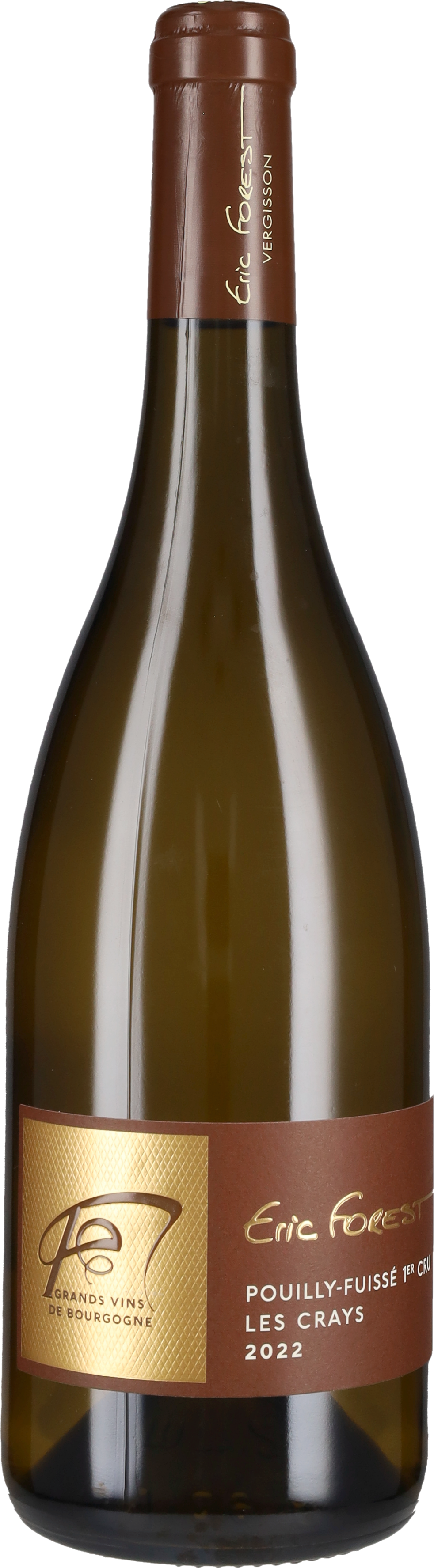
Pouilly Fuissé 1er Cru 'Les Crays' Eric Forest 2023The ‘Les Crays’ Pouilly-Fuissé Premier Cru by Eric Forest represents a classy label characterized by an enveloping opulence. The small Burgundy Domaine Eric Forest consists of about 9 hectares spread over exceptional denominations of the Mâconnais, where the Forest family has been passing down the vineyards and winemaking knowledge for eight generations. Eric performs all agronomic operations by hand, aiming to be rigorously precise and taking the utmost care of the plants. Of the total 9.5 hectares belonging to the Premier Cru ‘Les Crays’, the winery owns as much as 2.16. Eric Forest Pouilly-Fuissé ‘Les Crays’ Premier Cru comes from only old Chardonnay plants exposed to the south. The grapes come from different plots planted between 1930 and 1966 on soils formed by limestone gravel on a substrate of blue marl originating during the geological stage of the Pliensbachian, which in turn dates back to the Jurassic period. Once the right ripeness is reached, the clusters are hand-picked and then gently pressed, with the must thus obtainedthat undergoes spontaneous alcoholic fermentation. Subsequently, the wine is placed in oak barrels where it rests for about 12-18 months before bottling, with reduced doses of sulfites. To the eye, the Pouilly-Fuissé ‘Les Crays’ Premier Cru by Eric Forest shows a straw yellow color tending towards golden. The aromatic profile is vast and intriguing with its scents of dried fruit, white flowers, citrus, apricot, pear, orange marmalade, mimosa, and honey, enriched by delicate woody notes. The taste is deep, with a rich and soft body well balanced by the taut fresh-salty shoulder. The finish is very long and saline, reminiscent of the olfactory perceptions.60,00 £*Shipping: 48,00 £Secure redirect to the provider
-
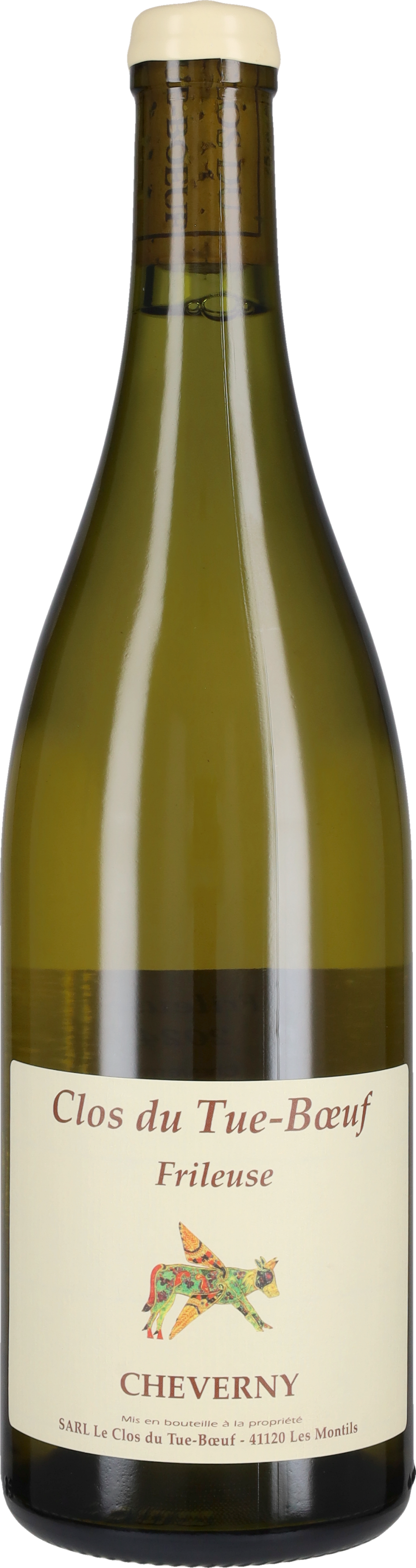
Cheverny 'Frileuse' Clos du Tue Boeuf 2024Clos du Tue Boeuf introduce lo Cheverny ‘Frileuse’ un vino bianco della Loira dal raffinato carattere agrumato. L’AOC di Cheverny si trova a est della zona di Touraine e offre vini bianchi, rosati e rossi prodotti a partire da diversi vitigni. La cantina Clos du Tue Boeuf opera in regime biologico, certificato da oltre 25 anni, eseguendo le lavorazioni del suolo in parte con l’ausilio di un cavallo, al fine di non compattare eccessivamente il terreno. Lo stesso approccio rispettoso della materia prima è adottato in cantina, con ridotti e mirati interventi enologici e vinificazioni parcellari. Lo Cheverny ‘Frileuse’ Clos du Tue Boeuf consta di un assemblaggio di Sauvignon Blanc, Fié Gris e Chardonnay in parti uguali, allevati su terreni argillosi ricchi di selce. Le piante hanno un’età compresa tra i 4 e i 50 anni e sono coltivate secondo i principi dell’agricoltura biologica certificata. A seguito della vendemmia, la fermentazione alcolica si realizza in botti di rovere grazie all’azione dei soli lieviti indigeni. Anche il successivo periodo di maturazione ha luogo in botti di legno, in parte borgognone e in parte demi-muids. Il liquido è infine imbottigliato senza subire alcuna filtrazione. Nel calice, il Clos du Tue Boeuf ‘Frileuse’ Cheverny assume una colorazione giallo paglierino dai riflessi verdolini. Il corredo aromatico è fine e delicato, definito da descrittori di agrumi, frutta tropicale e fiori bianchi che incontrano cenni erbacei e minerali. Equilibrato e coerente in bocca, dove freschezza e mineralità vanno di pari passo assieme a percezioni agrumate. In virtù della sua scorrevolezza e del gusto bilanciato, lo Cheverny ‘Frileuse’ è ideale da gustare in accompagnamento ad antipasti e primi piatti di mare oppure a formaggi di leggera o media stagionatura.32,00 £*Shipping: 48,00 £Secure redirect to the provider


-
Do you say "Du backst" or "Du bäckst"?
The correct spelling is "Du backst." The verb "backen" is conjugated as "backst" in the second person singular form. The umlaut on the letter "a" is not used in this conjugation. **
-
Is it said "Du backst" or "Du bäckst"?
The correct form is "Du backst." The verb "backen" means "to bake" in German, and when conjugated for the second person singular (du), it takes the form "backst." The umlaut (ä) in "bäckst" is incorrect in this context. **
-
Does it say "Du hältst" or "Du hältst"?
It says "Du hältst." **
-
Does it say "Du backst" or "Du bäckst"?
It says "Du backst." The verb "backen" (to bake) is conjugated as "backst" in the second person singular form in the present tense. The form "Du bäckst" would be incorrect in standard German. **


Why do we say "du hältst" but not "du setzt" instead "du setzt dich"?
In German, the verb "setzen" typically requires a direct object, so when using it in the second person singular form, it is often accompanied by a reflexive pronoun to indicate that the action is being performed on oneself. This is why we say "du setzt dich" instead of just "du setzt." On the other hand, the verb "halten" does not require a direct object, so it can be used on its own without a reflexive pronoun, resulting in "du hältst." This distinction in usage is a characteristic of the German language and its grammar rules. **
What does "Du weißt nicht, was du willst?" mean?
"Du weißt nicht, was du willst?" is a German phrase that translates to "You don't know what you want?" in English. It is often used to express frustration or confusion towards someone who seems indecisive or unsure about their desires or intentions. The phrase can be used in various contexts, such as in relationships, decision-making, or when someone is being wishy-washy about their choices. **
Top-Angebote
Products related to Pouilly-Fuissé-Clos-du:
-
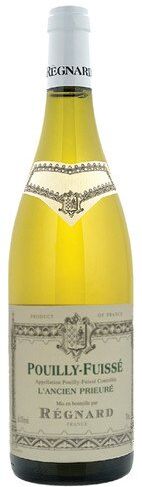
Pouilly Fuissé 'Clos du Pavillon' Regnard 2023The Pouilly Fuissé “Clos du Pavillon” from the Regnard winery is a fresh and mineral white wine produced in the historic Clos du Pavillon in the Mâconnais area, the southern part of the Burgundy region in France. This label is made from pure Chardonnay grapes sourced from vines trained on trellises using the double Guyot method, located at altitudes between 200 and 300 meters and characterized by marine-origin soils rich in clay, limestone, and fossil corals that can withstand erosion. The winery is one of the oldest and most renowned maisons in Burgundy, now owned by Baron Patrick de Ladoucette. “Clos du Pavillon” Pouilly Fuissé from Regnard is produced with carefully selected and hand-picked grapes, generally around mid-September. The bunches brought to the winery undergo a gentle destemming and pressing to obtain the free-run must, leading to alcoholic fermentation that takes place at low temperatures in stainless steel containers for several weeks.After that, the wine is racked and transferred into French oak barriques where malolactic fermentation and aging take place, lasting at least until the year following the harvest. The Pouilly Fuissé “Clos du Pavillon” presents a pale straw yellow color with slight greenish reflections. On the nose, intense aromas of ripe yellow fruit and citrus appear, including peach and cedar, floral notes of yellow flowers and cut grass, finishing with sweet hints of acacia honey. On the palate, it is lively, vibrant, and balanced, characterized by a great minerality that gives freshness to the sip, making it extremely pleasant. This Pouilly Fuissé from the Regnard winery is a Chardonnay of great finesse, complexity, and charm.48,00 £*Shipping: 48,00 £Secure redirect to the provider
-
Pouilly Fuissé 'Les Courtelongs' Saumaize 2024The Pouilly Fuissé “Les Courtelongs” Saumaize is a French white wine where body and refinement come together in a highly aromatic profile, from which the olfactory richness of Chardonnay grown in the south of Burgundy emerges. A fresh sip fuels a cautious and reflective drink, highlighting a particular intensity and taste tension. A label that still has several years of evolution ahead, presenting itself as an excellent investment for the future. To be tried with a seafood risotto or with a grilled fish dish. The Pouilly Fuissé “Les Courtelongs” by Saumaize originates from pure Chardonnay grapes, cultivated in plots characterized by a subsoil rich in gravel, silt, and clay. The vineyard is treated with the utmost respect, without using synthetic chemical products and minimizing the passage of tractors and mechanical means, oxygenating the land with light plowing. The must ferments in barriques, 20% new, and every phase of the winemaking process is followed with the utmost care for the details. The final part of the aging continues in barriques for 10 months, until the winery deems it ready for bottling. “Les Courtelongs” Pouilly Fuissé signed by Saumaize presents itself visually with a beautiful color, reminiscent of the hue of gold. Rich and multifaceted on the nose, moving between hints of fresh citrus and sweet notes of honey, where a note of nuts is also appreciated. On the palate, it is full-bodied, concentrated, and decisive thanks to a fragrant sip that flows with punctuality. It closes with a finish with excellent persistence. An artisanal label from the south of Burgundy, which carries and preserves the beauty of this territory.44,00 £*Shipping: 48,00 £Secure redirect to the provider
-
Latour Louis Pouilly Fuissé Louis Latour 2024The Pouilly Fuissé by Louis Latour is a pure Chardonnay, produced in the beautiful region of Mâconnais, located in the southern part of Burgundy. It is a land particularly suited for great whites, where Chardonnay expresses itself with an aromatic profile that is ripe, fresh, and mineral. The aging solely in steel highlights especially the refined floral and fruity notes of the grape variety and the mineral characteristics of the terroir. The Pouilly Fuissé wine is part of the vast range of labels that Louis Latour produces in Burgundy. The Domaine was founded at the end of the 1700s and still today represents one of the most important realities of the territory and a quality benchmark for the wines of the region. The property includes 28 hectares classified as Grand Cru of the Côte-d'Or and another 30 hectares in other prestigious areas. The Pouilly-Fuissé Appellation is located in the heart of the wonderful vineyard landscape of Mâconnais, an area that extends for about thirty kilometers between Sennecey-le-Grand and Saint-Vérand, bounded by the Grosne valley to the west, and by that of the Saône to the east. The favorable climate and the soils composed of limestone, clay, and silt have proven for centuries to be perfect for Chardonnay, which occupies over 80% of the vineyard, producing rich, ripe wines with a strongly territorial character. The vines have an average age of about 30 years and produce with low yields of about 45 hectoliters per hectare. At the end of the manual harvest, the grapes are gently pressed and the must is fermented at controlled temperature. The wine undergoes complete malolactic fermentation and matures for 8-10 months in stainless steel tanks before being bottled. The white Pouilly Fuissé from the famous Domaine Louis Latour is a Burgundy Chardonnay that expresses with great fidelity the characteristics of the Mâconnais terroir. It presents itself with a straw yellow color with slight greenish reflections. The olfactory profile opens with aromas of white flowers, balsamic and menthol sensations, ripe fruity aromas, and hints of flint. The sip is rich and satisfying, with a beautiful length and aromatic persistence, with a fresh, savory, and mineral finish.53,00 £*Shipping: 48,00 £Secure redirect to the provider
-
Pouilly Fuissé 'Ame Forest' Eric Forest 2022Within the area of Mâconnais, in southern Burgundy, the Pouilly-Fuissé ‘Ame Forest’ by vigneron Eric Forest is born, a complex white wine representative of the style of the area. “Ame” is an acronym derived from the initials of the names of Eric, his father Michel, and his grandfather André. It is a blend of the 4 freshest plots due to their exposure to the north and east: “La Côte”, “Tilliers”, “Les Bois Rosier”, and “Carmentrants”. The first gives power and structure, the second and third provide finesse and elegance, while the fourth offers opulence and depth. Eric Forest Pouilly-Fuissé ‘Ame Forest’ is a 100% Chardonnay from vineyards planted in 1963 by Eric's grandfather. The soils are partly made up of marl (La Côte) and partly of clayey limestone (Tilliers and Les Bois Rosier). After the harvest, carried out by hand, the grapes are gently pressed, with the subsequent alcoholic fermentation conducted exclusivelyby the yeasts present on the berries and in the cellar environment. Once the fermentation process is completed, the mass ages for a period between 12 and 18 months in oak barrels, followed by bottling by gravity and further resting in glass. The Burgundy label ‘Ame Forest’ Eric Forest Pouilly-Fuissé has an intense straw yellow color. The nose offers rocky and mineral hints, accompanied by notes of almond, apple blossoms, and white peach, as well as a faint hint of sweet spices. Soft, dense and satisfying on the palate, where the bright freshness and the persistent savory trail give agility to the tasting development. A Chardonnay from Mâconnais that pairs well with bold and elaborate flavors.44,00 £*Shipping: 48,00 £Secure redirect to the provider
-
What is the clos des chaulins 1989?
The Clos des Chaulins 1989 is a vintage wine from the Burgundy region of France. It is a red wine made from Pinot Noir grapes and is known for its complex flavors and aging potential. The 1989 vintage is highly regarded for its quality and is considered a classic example of Burgundian wine. It is sought after by wine enthusiasts and collectors for its rarity and exceptional taste. **
-
What does 'du brunzkache du ogsoachte' mean?
The phrase "du brunzkache du ogsoachte" is in the Bavarian dialect of German and translates to "you're crazy, you're delusional" in English. It is used to express disbelief or to dismiss someone's ideas or actions as irrational or nonsensical. **
-
Do you say "Du backst" or "Du bäckst"?
The correct spelling is "Du backst." The verb "backen" is conjugated as "backst" in the second person singular form. The umlaut on the letter "a" is not used in this conjugation. **
-
Is it said "Du backst" or "Du bäckst"?
The correct form is "Du backst." The verb "backen" means "to bake" in German, and when conjugated for the second person singular (du), it takes the form "backst." The umlaut (ä) in "bäckst" is incorrect in this context. **
Similar search terms for Pouilly-Fuissé-Clos-du
-
Pouilly Fuissé 1er Cru 'Les Crays' Eric Forest 2023The ‘Les Crays’ Pouilly-Fuissé Premier Cru by Eric Forest represents a classy label characterized by an enveloping opulence. The small Burgundy Domaine Eric Forest consists of about 9 hectares spread over exceptional denominations of the Mâconnais, where the Forest family has been passing down the vineyards and winemaking knowledge for eight generations. Eric performs all agronomic operations by hand, aiming to be rigorously precise and taking the utmost care of the plants. Of the total 9.5 hectares belonging to the Premier Cru ‘Les Crays’, the winery owns as much as 2.16. Eric Forest Pouilly-Fuissé ‘Les Crays’ Premier Cru comes from only old Chardonnay plants exposed to the south. The grapes come from different plots planted between 1930 and 1966 on soils formed by limestone gravel on a substrate of blue marl originating during the geological stage of the Pliensbachian, which in turn dates back to the Jurassic period. Once the right ripeness is reached, the clusters are hand-picked and then gently pressed, with the must thus obtainedthat undergoes spontaneous alcoholic fermentation. Subsequently, the wine is placed in oak barrels where it rests for about 12-18 months before bottling, with reduced doses of sulfites. To the eye, the Pouilly-Fuissé ‘Les Crays’ Premier Cru by Eric Forest shows a straw yellow color tending towards golden. The aromatic profile is vast and intriguing with its scents of dried fruit, white flowers, citrus, apricot, pear, orange marmalade, mimosa, and honey, enriched by delicate woody notes. The taste is deep, with a rich and soft body well balanced by the taut fresh-salty shoulder. The finish is very long and saline, reminiscent of the olfactory perceptions.60,00 £*Shipping: 48,00 £Secure redirect to the provider
-
Cheverny 'Frileuse' Clos du Tue Boeuf 2024Clos du Tue Boeuf introduce lo Cheverny ‘Frileuse’ un vino bianco della Loira dal raffinato carattere agrumato. L’AOC di Cheverny si trova a est della zona di Touraine e offre vini bianchi, rosati e rossi prodotti a partire da diversi vitigni. La cantina Clos du Tue Boeuf opera in regime biologico, certificato da oltre 25 anni, eseguendo le lavorazioni del suolo in parte con l’ausilio di un cavallo, al fine di non compattare eccessivamente il terreno. Lo stesso approccio rispettoso della materia prima è adottato in cantina, con ridotti e mirati interventi enologici e vinificazioni parcellari. Lo Cheverny ‘Frileuse’ Clos du Tue Boeuf consta di un assemblaggio di Sauvignon Blanc, Fié Gris e Chardonnay in parti uguali, allevati su terreni argillosi ricchi di selce. Le piante hanno un’età compresa tra i 4 e i 50 anni e sono coltivate secondo i principi dell’agricoltura biologica certificata. A seguito della vendemmia, la fermentazione alcolica si realizza in botti di rovere grazie all’azione dei soli lieviti indigeni. Anche il successivo periodo di maturazione ha luogo in botti di legno, in parte borgognone e in parte demi-muids. Il liquido è infine imbottigliato senza subire alcuna filtrazione. Nel calice, il Clos du Tue Boeuf ‘Frileuse’ Cheverny assume una colorazione giallo paglierino dai riflessi verdolini. Il corredo aromatico è fine e delicato, definito da descrittori di agrumi, frutta tropicale e fiori bianchi che incontrano cenni erbacei e minerali. Equilibrato e coerente in bocca, dove freschezza e mineralità vanno di pari passo assieme a percezioni agrumate. In virtù della sua scorrevolezza e del gusto bilanciato, lo Cheverny ‘Frileuse’ è ideale da gustare in accompagnamento ad antipasti e primi piatti di mare oppure a formaggi di leggera o media stagionatura.32,00 £*Shipping: 48,00 £Secure redirect to the provider
-
Touraine 'Guerrerie' Clos du Tue Boeuf 2022The Touraine “Guerrerie” of Clos du Tue Boeuf is born in France in the Loire Valley, precisely in Les Montils. The first traces of vine cultivation in this place date back to the medieval era, and the Puzelat family has managed to make the best use of this raw material, since they were historically farmers, polyculturists, and finally, winemakers, starting their activity in 1947, aiming to produce genuine wines linked to the territory of origin. Today, it is the subsequent generations that have taken the helm, expanding and modernizing the winery, always looking towards the future and the heritage that is passed down. The vineyards of the Touraine “Guerrerie” of Clos du Tue Boeuf extend over about 11 hectares, and the composition of the soil on which they grow is varied: clay, limestone, and gypsum are easily found, and in the areas most subject to rain, there are also pebbles and sand. The vines are about 35 years old and are entirely cultivated under organic management that was officially adopted in 1996: part of the land is managed and cultivated with the help of horses, in order not to compact the soil too much and keep it always lush and welcoming. The harvest is strictly manual, and in the winery, intervention is kept to a minimum: the must ferments spontaneously in oak vats and undergoes carbonic maceration for about 21 days. It ages for 10 to 12 months in barrique. The Touraine “Guerrerie” of Clos du Tue Boeuf appears in the glass as a bright ruby red, and the aromas recall red fruits and spices. On the palate, the structure is full, flavorful with a fresh and harmonious finish that invites drinking. Perfect to enjoy with grilled red meat, stews, but also with vegetarian dishes. An excellent product to consume during summer barbecues in the countryside with lifelong friends or for evenings by the fireplace in winter with an engaging read that accompanies the glass to savor a product that has all the hallmarks of being a good ambassador of the land from which it comes.31,00 £*Shipping: 48,00 £Secure redirect to the provider
-
Pinot Noir 'Caillere' Clos du Tue Boeuf 2023The Cheverny ‘Caillere’ Pinot Noir from the Clos du Tue Boeuf winery is a bottle of extraordinary pleasantness and dynamism. The viticultural reality of Clos du Tue Boeuf is located in the Loire Valley, between the areas of Touraine and Cheverny. The history of the Domaine seems ancient, as traces of vineyards have been found in the lieu-dit “Le Tue Boeuf” dating back to the Middle Ages, from which grapes were used to produce wines destined for royal tables. Today, the winery is run by brothers Jean-Marie and Thierry Puzelat, who, after a series of distinguished experiences in France and abroad, took over the estate in 1990. Clos du Tue Boeuf ‘Caillere’ Cheverny Pinot Noir comes from the homonymous black grape variety cultivated in soils composed of clay and flint. The vines, about 35 years old, are managed according to the principles of certified organic farming. After manual harvesting and careful sorting, the bunches are vinified in red without the use of enological additives and excluding the use of selected yeasts.selected. Once the fermentation process is complete, the mass rests between 10 and 12 months in oak barrels, after which it is bottled without undergoing any filtration. The Pinot Noir ‘Caillere’ Cheverny from Clos du Tue Boeuf has a brilliant ruby red color. The olfactory panorama expresses fragrant and articulated aromas of red berry fruits, dried flowers, and spices. On the palate, it is elegant and clean, fresh and juicy, with a fine tannic texture that anticipates a long fruity finish. Due to its characteristic freshness and finesse, this Pinot Noir pairs beautifully with medium-bodied meat dishes, such as pasta with white ragù, braised rabbit, or grilled lamb.36,00 £*Shipping: 48,00 £Secure redirect to the provider
-
Does it say "Du hältst" or "Du hältst"?
It says "Du hältst." **
-
Does it say "Du backst" or "Du bäckst"?
It says "Du backst." The verb "backen" (to bake) is conjugated as "backst" in the second person singular form in the present tense. The form "Du bäckst" would be incorrect in standard German. **
-
Why do we say "du hältst" but not "du setzt" instead "du setzt dich"?
In German, the verb "setzen" typically requires a direct object, so when using it in the second person singular form, it is often accompanied by a reflexive pronoun to indicate that the action is being performed on oneself. This is why we say "du setzt dich" instead of just "du setzt." On the other hand, the verb "halten" does not require a direct object, so it can be used on its own without a reflexive pronoun, resulting in "du hältst." This distinction in usage is a characteristic of the German language and its grammar rules. **
-
What does "Du weißt nicht, was du willst?" mean?
"Du weißt nicht, was du willst?" is a German phrase that translates to "You don't know what you want?" in English. It is often used to express frustration or confusion towards someone who seems indecisive or unsure about their desires or intentions. The phrase can be used in various contexts, such as in relationships, decision-making, or when someone is being wishy-washy about their choices. **
* All prices are inclusive of VAT and, if applicable, plus shipping costs. The offer information is based on the details provided by the respective shop and is updated through automated processes. Real-time updates do not occur, so deviations can occur in individual cases. ** Note: Parts of this content were created by AI.